🇵🇪 Peru Travel FAQ: Essential Information for First-Time Visitors
Peru is one of the most diverse and rewarding destinations in South America, offering world-class archaeology, dramatic landscapes, rich Indigenous culture, and exceptional food. This guide brings together the most important questions American travelers ask before visiting Peru, covering planning, entry requirements, money, flights, communication, and more. Each answer begins with a short, direct explanation, followed by helpful details for deeper context.
GENERAL INFORMATION & PLANNING
What is Peru best known for?
Peru is best known for Machu Picchu, its Inca heritage, world-class cuisine, and diverse natural landscapes.
Peru’s global reputation is anchored in several distinctive attributes:
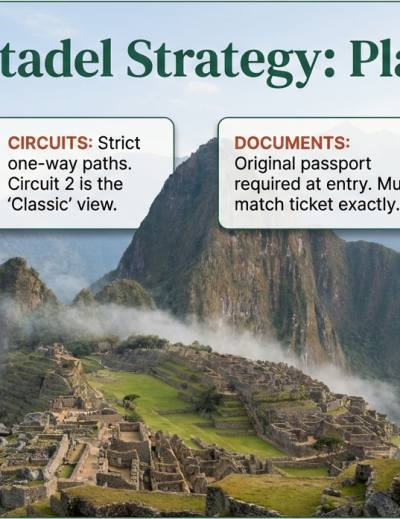
- Machu Picchu: The 15th-century Inca citadel and UNESCO World Heritage Site (inscribed 1983) attracts over 1.5 million visitors annually (Ministerio de Cultura, 2024).
- Cuisine: Recognized internationally for its fusion of Indigenous, Spanish, African, Chinese, and Japanese influences. Lima has been named the World’s Leading Culinary Destination 11 times by the World Travel Awards (2012–2023). Signature dishes include ceviche, lomo saltado, and anticuchos, while the Pisco Sour is considered the national cocktail.
- History and Heritage: The Inca Empire’s legacy remains visible in Cusco, once the imperial capital. It preserves pre-Columbian walls and colonial-era architecture.
- Nature and Biodiversity: From the Andes and Amazon Rainforest to the Pacific coast, Peru contains 84 of the Earth’s 117 life zones (CONABIO, 2022). It’s one of the world’s top five megadiverse countries, with over 4,000 potato varieties and hundreds of endemic species.
- Adventure Travel: Surfing hotspots like Chicama (home to one of the world’s longest waves) and hiking destinations like the Inca Trail enhance its outdoor appeal.
Main sources: UNESCO; PromPerú; World Travel Awards; Ministerio de Cultura del Perú.
What is the most beautiful part of Peru?
The Sacred Valley is often considered one of the most beautiful parts of Peru, though the Andes, Machu Picchu, and Colca Canyon rival it in scenery.
Different regions define Peru’s beauty through their geography and cultural landscapes:
- Sacred Valley (Urubamba Valley): Known for terraced hillsides, Inca ruins such as Ollantaytambo and Pisac, and traditional Quechua communities.
- Machu Picchu: Frequently ranked among the New Seven Wonders of the World, it showcases dramatic Andean and jungle vistas.
- Rainbow Mountain (Vinicunca): Reached an altitude of 5,200 m and displays natural mineral layers that create its unique striped coloration.
- Colca Canyon: At over 3,270 m deep (twice the Grand Canyon), it’s one of the world’s deepest canyons (INGEMMET, 2023).
- Arequipa: A UNESCO city built primarily from white volcanic sillar stone, framed by the Misti, Chachani, and Pichu Pichu volcanoes.
Sources: UNESCO; INGEMMET; National Geographic.
What is the nicest city in Peru?
Cusco and Lima are generally regarded as Peru’s most appealing cities for visitors.
- Lima: Peru’s capital and largest city, home to 10 million residents (INEI, 2024). Its top attractions include the historical center (UNESCO-listed), museums like the Larco and MALI, and a celebrated restaurant scene featuring Central, Maido, and Kjolle, three of The World’s 50 Best Restaurants 2024.
- Cusco: The archaeological capital of the Americas and a UNESCO World Heritage Site. Its blend of Inca walls and Spanish colonial buildings makes it a cultural highlight and gateway to Machu Picchu.
- Arequipa: Often called the “White City,” it offers baroque architecture and proximity to natural wonders like Colca Canyon.
- Iquitos: Accessible only by plane or river, this city is a primary base for Amazon River cruises.
- Trujillo: Known for pre-Columbian archaeological sites like Chan Chan (UNESCO-listed) and colonial mansions.
Sources: INEI; UNESCO; The World’s 50 Best Restaurants; PromPerú.
What is the number one tourist attraction in Peru?
Machu Picchu is Peru’s number one tourist attraction, drawing over 1.5 million visitors annually.
Built around 1450, Machu Picchu is considered the masterpiece of Inca engineering and a UNESCO World Heritage Site (1983). It’s located at 2,430 m above sea level and covers approximately 32,590 hectares including surrounding protected zones (SERNANP, 2024). Cusco serves as the principal hub for travelers heading to this site via train or the Inca Trail.
Sources: UNESCO; SERNANP; Ministerio de Cultura del Perú.
What is the most visited place in Peru?
Machu Picchu is the most visited place in Peru.
Over 1.5 million tourists visited Machu Picchu in 2023, according to the Peruvian Ministry of Culture. The site accounts for nearly 80% of Peru’s total archaeological tourism. Cusco and the Sacred Valley follow as key destinations due to their proximity and cultural ties.
Sources: Ministerio de Cultura del Perú (2024)
What is the nicest part of Peru?
The Sacred Valley and the southern highlands around Cusco are often called the nicest areas for scenery and culture.
These regions combine dramatic landscapes, authentic Indigenous traditions, and historic ruins. The Sacred Valley offers markets, farming terraces, and Inca remains set against mountain vistas. Visitors also praise the Colca Canyon, Rainbow Mountains, and Titicaca region for their photogenic beauty and local hospitality.
Sources: Lonely Planet; National Geographic Traveler.
Is Peru friendly to the US?
Yes. Peru maintains friendly relations with the United States and welcomes American travelers warmly.
Peru and the United States have enjoyed diplomatic relations since 1827. The U.S. is Peru’s top foreign investor and second-largest source of tourists (U.S. Department of State, 2024). English is increasingly spoken in tourist zones, especially in Lima and Cusco, and Americans can travel to Peru visa-free for up to 183 days.
Sources: U.S. Department of State; Embassy of Peru in Washington.
Is Peru good for family travel?
Yes, Peru is an excellent destination for family travel when itineraries are planned with altitude and logistics in mind.
Families often enjoy:
- Train journeys to Machu Picchu via PeruRail or IncaRail.
- Wildlife spotting in the Amazon (Tambopata National Reserve or Pacaya Samiria).
- Cultural workshops like pottery or weaving in the Sacred Valley.
Health experts recommend gradual altitude acclimatization from Cusco (3,400 m) before visiting higher sites.
Sources: PromPerú; CDC Traveler’s Health; PeruRail.
Is Peru suitable for solo travelers?
Yes. Peru is considered safe and rewarding for solo travelers, especially along established tourist routes.
Peru ranks among South America’s most popular backpacking destinations due to its strong hostelling infrastructure and guided tour options. Machu Picchu, Cusco, Arequipa, and Huaraz are well-known for safe and social travel environments. Visitors are advised to use official taxis, avoid displaying valuables, and stay in registered accommodations.
Sources: U.S. Department of State Travel Advisory; PromPerú; Hostelworld 2024.
What language is spoken in Peru?
Spanish is the official and most widely spoken language in Peru.
Spanish is spoken by roughly 84% of the population (INEI, 2023), while Quechua and Aymara are also official languages in regions where they predominate. Over 3 million Peruvians speak Quechua, particularly in Cusco, Puno, and Ayacucho. Bilingual education is promoted in Indigenous areas, and English is commonly understood in tourist hubs.
Sources: INEI; Ministerio de Cultura del Perú; UNESCO Atlas of the World’s Languages.
ENTRY & DOCUMENTS
Do US citizens need a visa for Peru?
No, US citizens don’t need a visa to visit Peru for tourism stays up to 90 days.
- Visa-Free Stays: US citizens can visit Peru for tourism or business without a visa for periods up to 90 days within a 183-day window, but immigration officials may grant stays up to 183 days at their discretion. The permit’s exact length is determined on arrival and noted on the passport stamp.
- Border Control: You must receive an entry stamp upon arrival—keep a copy or a photo of the stamp.
- Extensions: Stay extensions may be possible at immigration offices but are not guaranteed; fines apply if overstaying.
Sources: U.S. Department of State, Ministerio de Cultura del Perú, Skyscanner, Fertur Travel
Do Americans need a passport for Peru?
Yes, a valid US passport is required for entry.
- Validity Requirement: The passport must be valid for at least six months beyond your entry date, and one blank page is required for the entry stamp.
- Enforcement: Airlines may deny boarding if your passport is close to expiration.
- Tip: Carry a printed or digital copy of your passport info and entry stamp in case of loss or theft.
Sources: U.S. State Department
What documents do I need to travel to Peru?
A valid passport, return or onward ticket, and proof of accommodation.
- Passport: Must be valid for at least six months after your arrival.
- Onward Ticket: Proof of onward or return travel may be requested by both airlines and Peruvian immigration to show you will leave the country.
- Accommodation: Booking confirmation for a hotel, Airbnb, or tour may be required.
- Travel Insurance: Strongly recommended, though not legally mandatory, to cover medical, theft, and cancellations.
- Funds: You may be asked to show proof of sufficient funds for your stay.
Sources: Skyscanner, Follow Alice, Fertur Travel
What are the entry requirements for Peru?
A valid passport, immigration form, and compliance with customs regulations.
- Passport with 6-Month Validity: Strictly enforced for all visitors.
- Visa: Not required for US tourists (up to 90–183 days as granted by border officials).
- Immigration Form: Complete the form digitally or on arrival; you must receive a passport stamp.
- Customs: Declare any amount over $10,000 USD in cash, or restricted/prohibited goods.
- Children: Additional rules may apply for minors, such as showing birth certificates or parental authorization for solo travel.
Sources: Fertur Travel, U.S. State Department
How long can Americans stay in Peru without a visa?
Up to 90 days within a 183-day period. (Sometimes up to 183 days at the discretion of border officials.)
- Duration: The official policy is up to 90 days per visit, but stays up to 183 days may be granted on arrival, as per immigration officer discretion.
- Fines: Overstays incur daily fines, and longer visits require application at an immigration office.
Sources: Bushop
Do I need to show proof of onward travel when entering Peru?
Yes, you may be required to show proof of onward or return travel when entering Peru.
- Enforcement: Both airlines and immigration sometimes require proof, a return or departing flight or bus ticket; having a digital or printed copy is advised.
- Risk: Airlines may deny boarding for one-way tickets without such documentation.
Do I need travel insurance for Peru?
Insurance isn’t compulsory but is strongly recommended.
- Coverage: Good policies should include medical emergencies, altitude-related illness, loss/theft, and cancellation. Some tours and jungle lodges require proof of coverage.
- Benefit: Ensures access to private clinics and repatriation if needed.
What vaccines do Americans need for Peru?
No vaccines are legally required, but several are recommended.
- Recommended: Hepatitis A, typhoid, routine immunizations (MMR, DTP), and Yellow Fever for the Amazon Basin (required for continued travel to some regional countries).
- Consult: Check the CDC website or visit a travel clinic 4–6 weeks before your trip for location-specific guidance.
Sources: CDC
Can I enter Peru with an expired passport?
No, you cannot enter Peru with an expired passport.
- Requirement: The passport must be valid for at least six months after arrival or entry is refused.
Sources: U.S. State Department
What are the public holidays in Peru that may affect travel?
Major holidays are Holy Week (Semana Santa), Independence Day (July 28–29), Christmas–New Year.
- Impact: During these times, transport and hotels book fast, government offices close, and major cities hold festivals, significantly increasing local demand.
FLIGHTS & BOOKING
Where do you fly into Peru?
Most international flights arrive at Jorge Chávez International Airport (LIM) in Lima.
- Main Hub: The vast majority of international arrivals and all major domestic connections are through Lima.
Are there nonstop flights from the US to Peru? Which airlines fly direct?
Yes, several airlines fly direct from the US to Lima.
- Direct Flights: American, Delta, LATAM, and JetBlue fly from Miami, Dallas, Atlanta, New York, Los Angeles, and Houston.
- Duration: 6–8 hours depending on departure city.
How long is the flight from the US to Lima?
Direct flights from the US to Lima take about 6–8 hours.
- Examples: Miami–Lima is around 6 hours, Los Angeles–Lima about 8 hours.
- Time Difference: Peru is in GMT-5, typically just one hour behind the US East Coast.
What airport do you fly into for Machu Picchu?
Fly to Cusco’s Alejandro Velasco Astete International Airport (CUZ).
- Access: There are no direct flights to Machu Picchu. Travelers reach the site by taking a train from Cusco or the Sacred Valley (Ollantaytambo).
Is there a departure tax when leaving Peru?
No, international departure taxes are now included in airfare.
- No Cash Payment Needed: All international departures include tax in the flight ticket price.
How far in advance should I book a trip to Peru?
Book 2–3 months in advance for good prices and availability.
- High Season: (May–September) requires advance booking, especially for the Inca Trail, which sells out months ahead.
- Shoulder Season: Offers lower prices and more availability.
How long should I stay in Peru? / How many days are enough to visit Peru?
7–10 days is ideal to enjoy Peru comfortably.
- Suggested Breakdown: Machu Picchu/Cusco (3–4 days), Lima (1–2), Sacred Valley or Amazon (2–3). Extra days allow for altitude acclimatization.
How far in advance should I book Machu Picchu tickets?
1–2 months in advance; Inca Trail permits 4–6 months ahead.
- Peak Demand: May–September sells out quickly.
- Official Site: Buy tickets online via the Peruvian government or authorized agencies.
How to travel between Cusco, Lima, and the Sacred Valley?
Fly to Cusco, then travel by car or train to the Sacred Valley.
- Lima–Cusco: 1.5-hour flight.
- Cusco–Valley: 1–2 hours by scenic road; trains run from Poroy/Ollantaytambo to Machu Picchu.
COSTS & BUDGETING
How much does a 7-day trip to Peru cost?
$1,200–$2,500 per person, on average.
- Budget: $1,000.
- Mid-range: $1,500–$2,000.
- Luxury: $3,000+. Airfare, tours, and accommodations dominate costs.
Is Peru expensive to visit? / Are things cheap in Peru?
Peru is not expensive and things are generally affordable, especially for food and transport.
- Meals: $3–$10 at local restaurants.
- Transport: Buses/taxis are low-cost.
- Hotels: $50–$90/night mid-range. Touristic hotspots are slightly pricier but remain value-oriented.
Is USD worth a lot in Peru? / Is $100 a lot in Peru?
Yes, $100 USD stretches far in Peru.
- Purchasing Power: At about 380 soles (current rate), $100 covers several days of meals and transport for budget travelers.
How much should I budget daily in Peru?
$80–$150 per day, depending on travel style.
- Backpackers: $50–$70.
- Mid-range: $100–$130.
- Luxury: $200+. Major expenses include tours and transport.
Is Peru cheaper than Mexico or Costa Rica?
Yes, Peru is generally cheaper than both Mexico and Costa Rica.
- Accommodation: Typically 20–30% cheaper than Costa Rica.
- Meals: Cost less than in large Mexican cities.
- Tours: Entry and activities are competitive and often cheaper.
CONNECTIVITY & COMMUNICATION
Do US cell phones work in Peru?
Yes, most U.S. phones work if they’re unlocked and support GSM networks.
Major U.S. carriers have roaming agreements; enabling international roaming or using a local SIM improves cost-effectiveness.
Can I use Verizon in Peru?
Yes, Verizon works with international roaming, though rates can be high.
Activate Verizon TravelPass for flat daily rates; otherwise, disable roaming and use local SIMs or Wi-Fi.
Is there cell service in Machu Picchu?
Limited. Signal is weak or unavailable inside the ruins.
Coverage is available in “Aguas Calientes” but nearly absent inside the archaeological park. Plan offline with maps and coordination.
Can I use Wi-Fi in hotels and cafes?
Yes, Wi-Fi is common in hotels and urban cafes.
Wi-Fi speeds vary; cities have reliable connections, whereas Amazon lodges and remote areas may have limited service.
Should I buy a local SIM card in Peru?
Yes, it’s the cheapest way to stay connected.
Bring an unlocked phone and get a prepaid SIM at airports or local outlets. Passport registration is mandatory. Leading carriers include Claro, Movistar, and Entel.
Which mobile network works best for tourists?
Claro offers the best national coverage, followed by Movistar and Entel.
Claro excels in urban and highland zones; Movistar dominates in the Amazon; Entel covers southern areas well.
What’s the best SIM card for tourists in Peru?
Claro or Entel SIM cards are most reliable and easy to activate.
SIMs come with data packages and are top up available at convenience stores; expect to pay 10–20 soles ($3–5) initially.
Can I use WhatsApp or Google Maps easily?
Yes, both apps work seamlessly with local data or Wi-Fi.
WhatsApp is widely used for communication; Google Maps works well offline with pre-downloaded maps.
Is there mobile coverage on the Inca Trail or in Machu Picchu?
No, mobile coverage is very limited or nonexistent on the Inca Trail.
Between Cusco and “Aguas Calientes”, expect no service for several days. Prepare offline navigation and coordinate with guides before trekking.
Sources:
- Top Inka Travel
- PromPerú
- Ministry of Foreign Trade and Tourism (gob.pe)
- US Embassy Peru
- Local tourist boards
NEXT: EXPLORE THE FULL PERU FAQ SERIES
This page covers the essential first questions for planning a trip to Peru. For deeper guidance, continue with the dedicated FAQ pages in our Peru Travel Hub:
Peru Safety & Health Guide
Your guide to staying safe, understanding common scams, choosing hospitals, and knowing what to avoid.
Altitude & Acclimatization
How to prepare for high elevation, avoid altitude sickness, and adapt your itinerary safely.
Machu Picchu Planning Guide
Tickets, entrances, routes, trains, rules, packing, and everything you need to know.
Money, Payments & Tipping
Currency, ATMs, cards, exchange rates, tipping norms, and budgeting.
Best Time to Visit Peru
Weather by region, seasons, rainy vs dry months, and the ideal time for Machu Picchu and the Amazon.
Transportation & Itineraries
Getting around Peru by air, bus, taxi, train, and planning efficient multi-city routes.
Food & Drink Guide
Must-try dishes, food safety, drinks, breakfast habits, and the best regions for Peruvian cuisine.
Culture & Etiquette
Greetings, dress norms, market etiquette, customs, and respectful behavior.
Responsible Travel in Peru
Ethical tourism, respectful photography, and sustainable practices for supporting local communities.
Smart Traveler Tips for Americans
Practical advice, apps, emergency contacts, scams to avoid, and insider planning insights.