Who Plans the Family Trip? Parents Are Giving Up on Dream Travel More Often
Published on
Planning a big trip is hard for everyone. For American parents, it can feel especially hard. In our 2026 survey of 1,010 US adults, parents were the most likely group to say they had given up on a dream trip because the planning felt overwhelming.
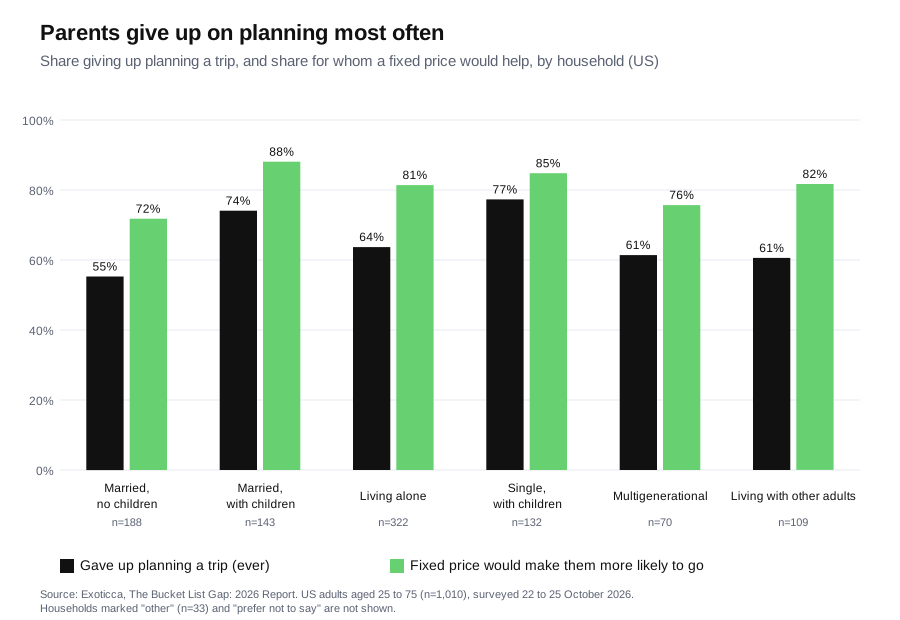
 Share who have given up planning a trip, and share for whom a fixed price would make them more likely to go, by household type. Sources: US adults aged 25 to 75 (n=1,010), October 2026. Download SVG · Download data (CSV)
Parents give up more often
Overall, 64% of Americans have given up planning a bucket list trip at least once. Among married parents with children under 18, the figure rises to 74%. Among single parents, it reaches 77%. Adults who live alone are at 64%, and married adults without children are at 55%.
Multigenerational households (61%) and adults living with other adults (61%) sit closer to the overall average, so the pattern is specific to households with children.
Cost is not what sets parents apart
Parents are not more likely than other Americans to name cost as their barrier. Among married parents, 58% name it, similar to the 53% of adults living alone. Among single parents, the figure is 51%. The difference between parents and others is not about money in our data.
What parents do stand out on is planning. They give up on a trip more often, even though cost is not a larger concern for them.
A bundled price matters most to parents
We asked respondents whether a single fixed price covering flights, hotels, transfers and tours would change their likelihood of going this year. Across the US, 80% said yes. Among parents, the share was higher: 88% of married parents and 85% of single parents said a fixed price would make them more likely to travel, compared with 81% of adults living alone.
A fixed price is most useful for the group that gives up most often. For a family, it means one set of decisions, one budget to track and fewer surprises once the trip has started.
Solo travellers face a different barrier
Adults who live alone were the most likely to say they had no one to travel with, at 18%. This compares with 5% of married adults without children. Single parents also name it, at 15%. Their planning problem is less about coordinating others and more about carrying the decisions alone.
Why the planning may weigh more on parents
The survey does not explain why parents give up more often. One possibility is that planning a trip for several people involves more flights, rooms, transfers and activities, all of which have to fit around school and work. That would make the planning itself heavier, even when the money is not the main concern.
This is a hypothesis we have not tested. A follow-up study that asks who in a household does the planning, and how much time it takes, would be needed to check it.
What this means for planning support
Content that helps a family choose a destination, set a budget and decide how much to book in advance is likely to address a real need. Packages that bundle the essentials remove the most time-consuming part of planning, which is the part parents are most likely to give up on.
This is our reading of the data, not a finding of the survey.
Note: these are survey associations. The data does not show what causes parents to give up more often. Income and other household factors may also play a role. Household groups of 70 to 322 respondents are used, so the smaller ones should be read with some caution.