The Gender Gap in Travel Budgets: Why Women Are More Likely to Say Cost Holds Them Back
Published on
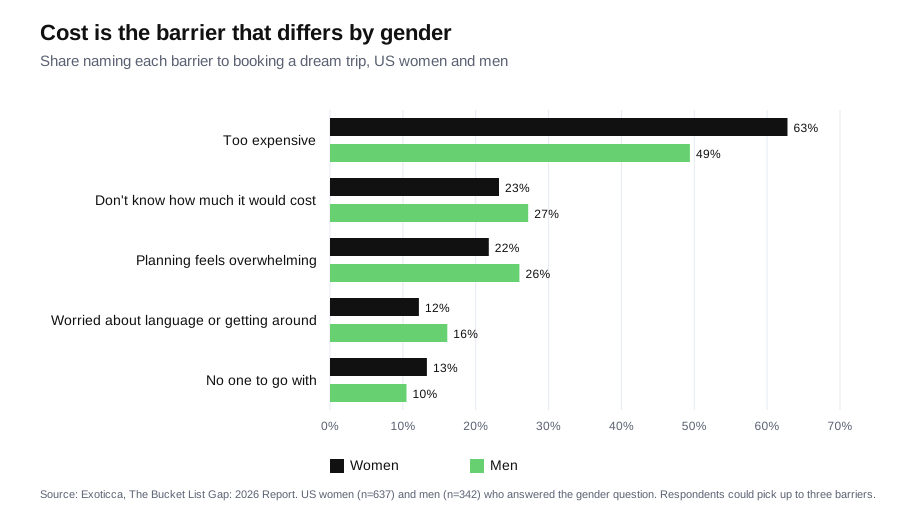
Cost is the top reason Americans give for not booking a dream trip, but the reason is not the same for everyone. In our 2026 survey, women were markedly more likely than men to name cost as their main barrier.
 Share naming each barrier to booking a dream trip, by gender. Respondents could pick up to three barriers. Sources: US women (n=637) and men (n=342), aged 25 to 75, October 2026. Download SVG · Download data (CSV)
The numbers
63% of women said “it’s too expensive” was holding them back, compared with 49% of men. That is a gap of about 13 percentage points.
The gap shows up in other places too. Women were slightly less likely to say they would go on a trip this year: their average likelihood score was 3.7 out of 10, against 4.0 for men. Both groups responded similarly to a bundled, fixed price: 80% of women and 79% of men said it would make them more likely to go.
The gap is about cost, not every barrier
On the other barriers, the two groups answer much the same, and in some cases men are higher. Men are more likely than women to say they do not know how much the trip would cost (27% against 23%), that planning feels overwhelming (26% against 22%), or that they are worried about language or getting around (16% against 12%). Women are more likely to say they have no one to go with (13% against 10%).
Cost is the only barrier where women are clearly ahead, and the difference is the largest on the chart.
Income explains part of it, but not all
Women in the sample were more likely to report household incomes below $25,000 (35% against 23% of men). Income is a clear driver of cost concerns, so we checked whether it explained the gap.
It does not explain all of it. Within each income band, women were still more likely than men to name cost as a barrier. The gap remained about 10 percentage points after we accounted for income, household type and age together.
Travel experience does not explain it either
Women in the sample are less likely to have taken a long-haul trip in the past five years (42% against 57% of men). Experience might be expected to lower the cost barrier, so we checked the gap within each group.
It holds in both. Among those who have taken a long-haul trip, 49% of women and 37% of men name cost as a barrier. Among those who have not, the figures are 73% and 66%. The gap is wider among those with less experience, but it is present in both groups.
What the survey cannot tell us
The survey shows an association, not a cause. It does not measure who controls household spending, who pays for travel, or whether women are more likely to be planning for others. Those questions would need a different study.
The following are hypotheses we have not tested. They are questions rather than findings:
- Household financial roles. If women are more likely to manage household budgets, they may be more attentive to the cost of any single trip.
- Planning for others. Women may be more likely to plan trips that include other people, which would raise the total cost of a trip in their minds.
What this means for content and planning
For women considering a trip, the most useful content is likely to be clear, upfront pricing and a breakdown of what is included. Reassurance about cost may matter more for this audience than messages about inspiration or planning help, which women are no more likely to mention than men.
This is our reading of the data, not a finding of the survey.
Note: the survey asked about gender as a single question. Results are based on self-reported answers and on samples of 637 women and 342 men. Respondents who preferred not to say are excluded.