The gender gap in travel costs is just as wide in the UK
Published on
Cost is the top reason Britons give for not booking a dream trip, but it does not hold everyone back equally. In our 2026 survey, British women were far more likely than men to name cost as a barrier. The difference is specific to money, and it holds up when we account for income.

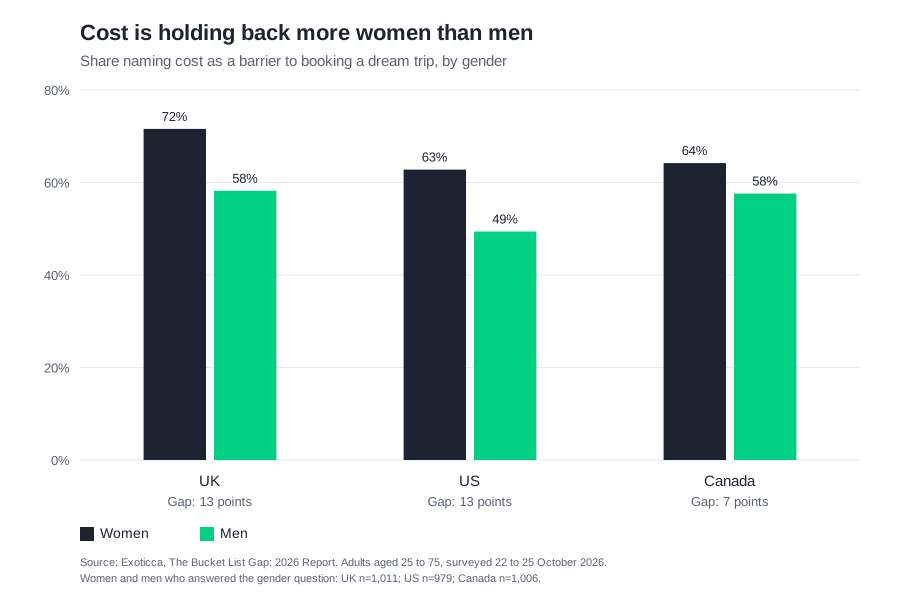
Share naming cost as a barrier to booking a dream trip, by gender. Sources: UK (women n=726, men n=285), US (women n=637, men n=342), Canada (women n=548, men n=458), aged 25 to 75, October 2026. Download SVG · Download data (CSV)
The numbers
72% of British women said cost was holding them back, compared with 58% of British men, a gap of about 13 percentage points. Women also rated their likelihood of travelling this year lower, at an average of 3.0 out of 10, against 4.0 for men.
Both groups responded similarly to a single, fixed price for flights, hotels, transfers and tours: 78% of women and 81% of men said it would make them more likely to go. So women are not less interested in a bundled price. They are more likely to say that cost, rather than something else, is what stops them from booking.
The gap is about money, not everything
To test whether women simply name more barriers, we compared the other reasons respondents gave. On most of them, the two groups answer much the same:
- Cost: 72% of women, 58% of men
- Planning feels complicated or overwhelming: 23% of women, 26% of men
- Don’t know how much it would cost in total: 22% of women, 23% of men
- Worried about safety: 11% of women, 13% of men
- Worried about language or getting around: 5% of women, 11% of men
- Not enough holiday days: 13% of women, 14% of men
Men are more likely than women to name language and getting around as a worry, and no other barrier shows a gap of more than a few points. The difference is specific to the cost of the trip.
Income explains part of the gap, not all of it
Women in our sample were more likely to report a household income below £25,000 (21.5%, against 16.5% of men). So we checked the cost gap within income bands.
It holds in both. Among those with incomes below £35,000, 78% of women and 60% of men named cost as a barrier. Among those earning £35,000 or more, the figures were 67% and 58%. The gap is wider at lower incomes, but it does not disappear at higher ones.
When we adjusted for income, household type and age together, British women were still about 11 percentage points more likely than men to name cost as a barrier. Most of the raw gap remains.
Experience does not explain it
Women are slightly more likely to have given up planning a trip at least once (54%, against 49% of men). But the share who have taken a long-haul trip in the past five years is almost the same for both groups (72% and 72%). Women and men who have travelled far are equally likely to say cost holds them back, so the gap is not simply a matter of experience.
The same gap appears in the US
Our US survey found a gap of the same size. There, 63% of women and 49% of men named cost as their main barrier. Two markets, one pattern.
Canada looks different. There, 64% of women and 58% of men named cost as a barrier, a gap of about 7 points. The pattern is not universal, which makes the UK and US results more worth explaining.
What the survey cannot tell us
This is an association, not a cause. The survey does not show who controls household spending, who pays for travel, or whether women are more likely to be planning for others. It also does not ask how each person feels about money within their household. Those questions would need a different study.
What this could mean for planners
If cost is the gap, reassurance about price is likely to matter more than inspiration for many women. Clear breakdowns of what is included, and upfront information about the costs that are not, may reach that audience better than general messages about value. This is our reading of the data, not a finding of the survey.
Note: results are self-reported. The UK comparison is based on 726 women and 285 men. Cross-market figures use the same question in each country.