Britons will let AI plan their trip, but very few will let it book
Published on
AI tools are now part of how many people plan a trip. In our 2026 survey, Britons were the most open of the three markets to using AI for the planning stage. But they drew a firm line at the purchase, and that line moves with age.
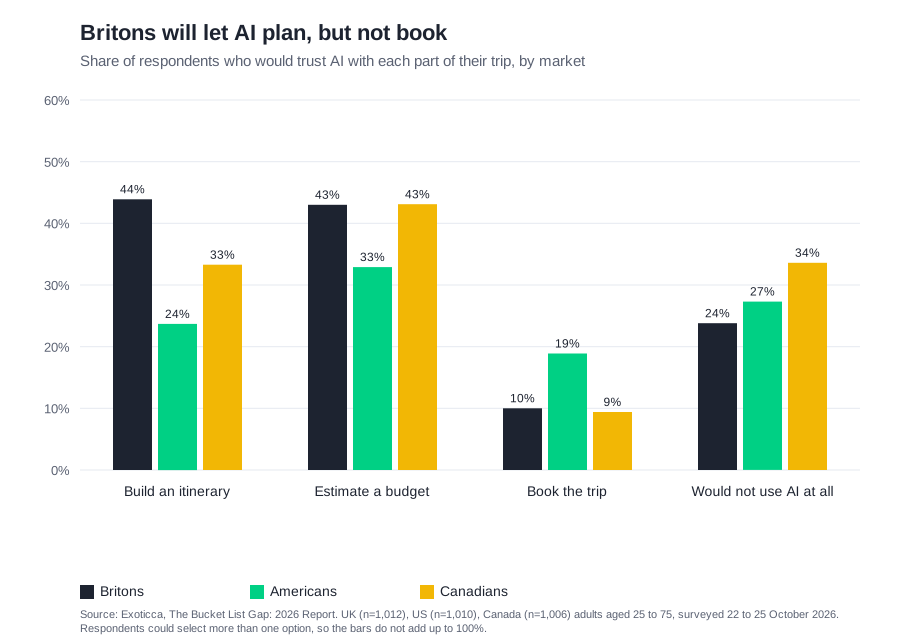
 Share of respondents who would trust AI with each part of their trip, by market. Respondents could select more than one option. Sources: UK (n=1,012), US (n=1,010), Canada (n=1,006), aged 25 to 75, October 2026. Download SVG · Download data (CSV)
Britons want AI to shape the plan
43.9% of Britons would trust an AI tool to build an itinerary, the highest share of the three markets. Americans came in at 23.7% and Canadians at 33.3%. Estimating a budget was just as popular: 43.0% of Britons would let AI do it, against 32.9% of Americans and 43.1% of Canadians. Suggesting destinations came next at 36.3%.
Few would let it book
Only 10.0% of Britons would let AI book their trip. Among Canadians the figure is 9.4%, and among Americans it is 18.9%, nearly double. Britons are more willing than others to let AI plan the trip, but when it comes to spending the money, they are as cautious as Canadians and more cautious than Americans.
Fewer rule AI out completely
23.8% of Britons said they would not use AI for planning at all. Among Americans the figure was 27.3%, and among Canadians 33.6%. The UK is the market where the fewest people rule AI out completely.
The age divide is the largest in the data
The biggest difference among Britons is not between countries but between generations. Among those aged 25 to 34, 18% said they would not use AI at all, and among those aged 35 to 44 the figure was 18%. Among those aged 55 to 64 it rose to 42%, and to 50% among those aged 65 to 75.
The appetite for AI-built itineraries also peaks in middle age. Around half of Britons aged 35 to 54 would trust AI to build one, against about a third of those aged 55 and over (36% at 55 to 64, 33% at 65 to 75). The willingness to let AI book is lower across the board, and falls to 2% among those aged 55 to 64, though that group is small.
What we do not know
The survey shows what people say they would trust AI with, not why. The following are hypotheses we have not tested, and should be read as questions rather than findings:
- Trust with money. Booking involves paying and being responsible if something goes wrong. Older travellers may be less willing to hand that step to a tool, whatever they think of its planning ability.
- Familiarity with the tools. Younger Britons may have used AI for everyday tasks, which could make them more comfortable letting it help with a trip.
Answering these questions would need a follow-up study that asks people how they feel about each step of planning, and why.
What this means for planning
For brands and planners, the opportunity is to meet British travellers at the planning stage with clear, detailed itineraries and budget information. Many will use AI to shape a trip, so a plan that reads well to a tool is likely to reach them earlier.
The purchase still needs a clear route, with visible terms, a human point of contact and transparent pricing. This matters most for older travellers, where around four in ten or more say they would not use AI at all.
Note: these are stated preferences from surveys. The data shows what people say they would trust AI to do, not how they behave when ready to book. The age groups aged 55 to 64 and 65 to 75 are smaller samples, so their figures should be read with some caution.