Le Due Torri, Bologna’s Medieval Icons
The skyline of Bologna is instantly recognizable thanks to Le Due Torri, the Asinelli and the Garisenda. Rising at the entrance of the ancient Via Emilia, these two medieval towers have shaped the city’s identity for nearly a thousand years.
During the Middle Ages, Bologna was once home to an extraordinary number of towers, historians estimate between 100 and 180. Today, only about twenty remain, making Le Due Torri powerful reminders of a time when architecture reflected social status, political rivalry, and defensive strength.
The Two Towers at a Glance
Torre degli Asinelli
The Asinelli Tower reaches a height of 97.2 metres, making it the tallest leaning medieval tower in the world. Built between 1109 and 1119, it tilts gently at about 1.3 degrees, a lean that becomes more noticeable the longer you stand beneath it.
When accessible, visitors can climb 498 narrow wooden steps to the top. The ascent is physically demanding, but the reward is a wide panorama over Bologna’s terracotta rooftops, Piazza Maggiore, and the surrounding hills of Emilia Romagna. Late afternoon and sunset are especially popular times to visit, when the city takes on warmer tones.
Torre della Garisenda
Shorter but far more dramatic, the Garisenda Tower stands 48 metres tall and leans at approximately 4 degrees, even more than the Leaning Tower of Pisa. Originally built to around 60 metres, its upper section was removed in the 14th century after structural instability made it unsafe.
The tower gained literary recognition through Dante Alighieri, who mentioned it in the Inferno. He used its striking tilt as a visual metaphor, securing the Garisenda’s place in Italian cultural history.
Why the Towers Were Built

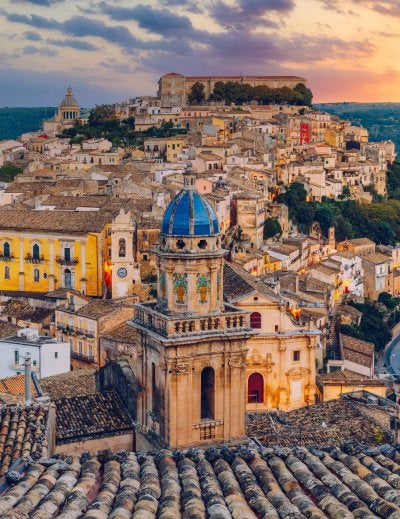
Aerial view of Bologna Cathedral and towers towering above of the roofs of Old Town in medieval city Bologna in the sunny day, Emilia-Romagna, Italy
Symbols of Power and Prestige
Le Due Torri were constructed by the Asinelli and Garisenda families during the Investiture Controversy, a period marked by tensions between religious and secular authorities. Wealthy families built towers as fortified residences and as visible statements of influence within the city.
Their strategic location near the Via Emilia allowed families to monitor movement through Bologna and assert control over key access points.
A City Defined by Towers
At its medieval peak, Bologna’s skyline was dense with towers, many of which stood close together in the city centre. Several once rose in Piazza di Porta Ravegnana alone, though most were dismantled over time as they became unsafe or unnecessary.
Science, Conflict, and Survival
A Centre of Scientific Experimentation
In the 17th century, the Asinelli Tower became an unexpected scientific landmark. Physicist Giovanni Battista Guglielmini conducted experiments by dropping objects from the tower to study Earth’s rotation, decades before similar demonstrations elsewhere in Europe.
Enduring Through Turbulent Times
Both towers have survived centuries of lightning strikes, fires, and armed conflict. During the Second World War, Allied pilots reportedly joked about hitting the towers, yet they emerged largely unscathed.
Engineering Challenges and Preservation
The Fragility of the Garisenda
The Garisenda rests on a base of selenite, a gypsum-based stone that has weakened over time due to humidity, heat, and environmental exposure. Medieval fires altered the stone’s composition, contributing to internal deterioration.
Modern conservation efforts rely on steel reinforcement, containment systems, and continuous monitoring to limit movement and prevent further damage.
Monitoring the Asinelli
The Asinelli Tower is closely observed using advanced sensors that detect even minor structural changes. Its sensitivity is such that it can register distant seismic activity, making it valuable not only as a historic monument but also as a scientific reference point.
Visiting Le Due Torri Today
Location and Practical Access
Le Due Torri are located in Piazza di Porta Ravegnana, in the heart of Bologna’s historic centre. When available, access to the Asinelli Tower requires advance booking, as visitor numbers are limited.
There are no lifts, and the climb is not suitable for visitors with limited mobility or certain medical conditions.
Experiencing the Surroundings
Even without climbing, the area around the towers is one of the most atmospheric parts of the city. In the evening, when the towers are illuminated and cafés fill the square, it is an ideal place to pause and take in Bologna’s everyday rhythm.
Curious Facts About the Two Towers
Traditions and Superstitions
A long-standing local belief warns students not to climb the Asinelli before graduation, or they may never complete their studies. Many students still follow this tradition today.
Unusual Historical Details
In 1513, a celebratory cannon shot accidentally struck the Asinelli during festivities marking the election of a new pope, yet the tower remained intact. In a city known for its cuisine, locals have also calculated that more than 12,000 strands of cooked tagliatelle laid side by side would equal the height of the Asinelli.
Planning Your Time in Bologna
Getting Around the City
Bologna is compact and easy to explore on foot, thanks in part to its extensive network of covered porticoes. For longer distances, the local bus system offers a convenient option.
Best Time to Visit
Late summer and early autumn tend to offer comfortable temperatures and fewer crowds, making them ideal seasons for exploring the historic centre.
To round out your itinerary, browsing things to do in Bologna can help you combine Le Due Torri with food markets, museums, and nearby excursions.
Discover Bologna with Exoticca
Le Due Torri are central to Bologna’s identity, but they are just one part of a broader Italian experience. With Exoticca, travellers can explore Bologna through carefully planned trips and itineraries that highlight Italy’s cultural, historical, and regional diversity.
Exoticca creates complete travel experiences that include flights, accommodation, and guided sightseeing, allowing travellers to focus on discovery rather than logistics. Whether Bologna is one stop on a wider Italian journey or part of a multi-city European itinerary, travelling with a structured plan helps make the most of every destination.